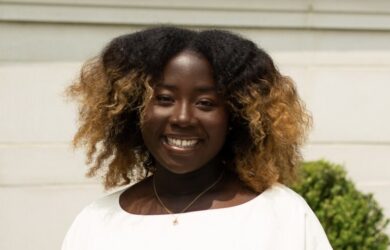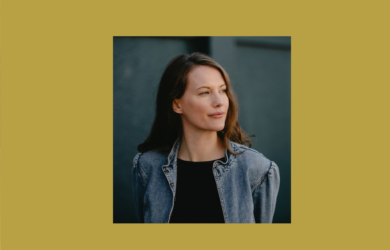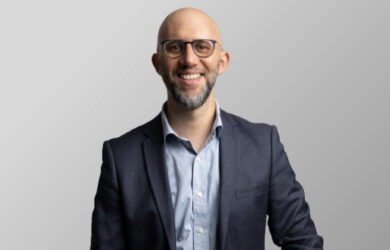


Iryna Shuvalova, Njoki Wamai and Sara Clarke-Habibi discuss the role of culture in peacebuilding in the latest episode of the Gates Cambridge podcast
Culture plays a crucial role in peacebuilding and can challenge narratives of conflict and division, according to the latest episode of the Gates Cambridge podcast So, now what?
In the episode, hosted by presenter Catherine Galloway, Njoki Wamai [2012], Iryna Shuvalova [2016] and Sara Clarke-Habibi [2011] explore the role of culture in peacebuilding and the need to challenge narratives of conflict and division.
They discuss their experiences in conflict-affected regions and the importance of empathy, healing and resilience in creating cultures of peace.
They highlight the need for education systems to promote peace and inclusion, and the importance of dismantling oppressive narratives and amplifying the voices of marginalised communities. The conversation concludes with a call to action to reform education, support cultural workers, and create spaces for dialogue and understanding.
Njoki Wamai is Assistant Professor of Politics and International Studies at United States International University-Africa, Kenya. Her work has mainly focused on power, citizenship in the context of international interventions like the International Criminal Court and transitional justice in Africa, African feminisms and decolonial research practices. She won the Bill Gates Sr Prize in 2016.
Iryna Shuvalova is a Kyiv-born and perpetually peripatetic poet, translator and scholar who is interested in disentangling complex webs of identity and belonging in Ukraine and beyond. Her research interests lie at the intersection of culture and politics in Eastern Europe. In her current role as a Postdoctoral Research Fellow at the University of Oslo, she examines the use of popular culture as a medium of manipulation and propaganda in the regions of Ukraine occupied by Russia.
Sara Clarke-Habibi has worked in the field of peacebuilding through education for over 20 years as a practitioner, researcher, curriculum developer and trainer. Her work focuses on educational intersections with violent conflict, displacement, transitional justice, collective trauma, social healing, post-conflict peacebuilding and intergroup reconciliation. She currently works for the United Nations Institute for Training and Research (UNITAR), Division for Peace, in Geneva. Her latest publications include “Peace Pedagogies in Bosnia and Herzegovina: Theory and Practice in Formal Education” (Springer, 2023) and “From Trauma-Sensitive to Trauma-Responsive Peacebuilding” (Routledge, forthcoming).
The last episode of the current season of So, now what? focuses on global health, features Sabrina Anjara [2014], Victor Roy [2009] and Johanna Riha [2011] and will be available from the end of August.
*To listen to the episode on peacebuilding, click here.