

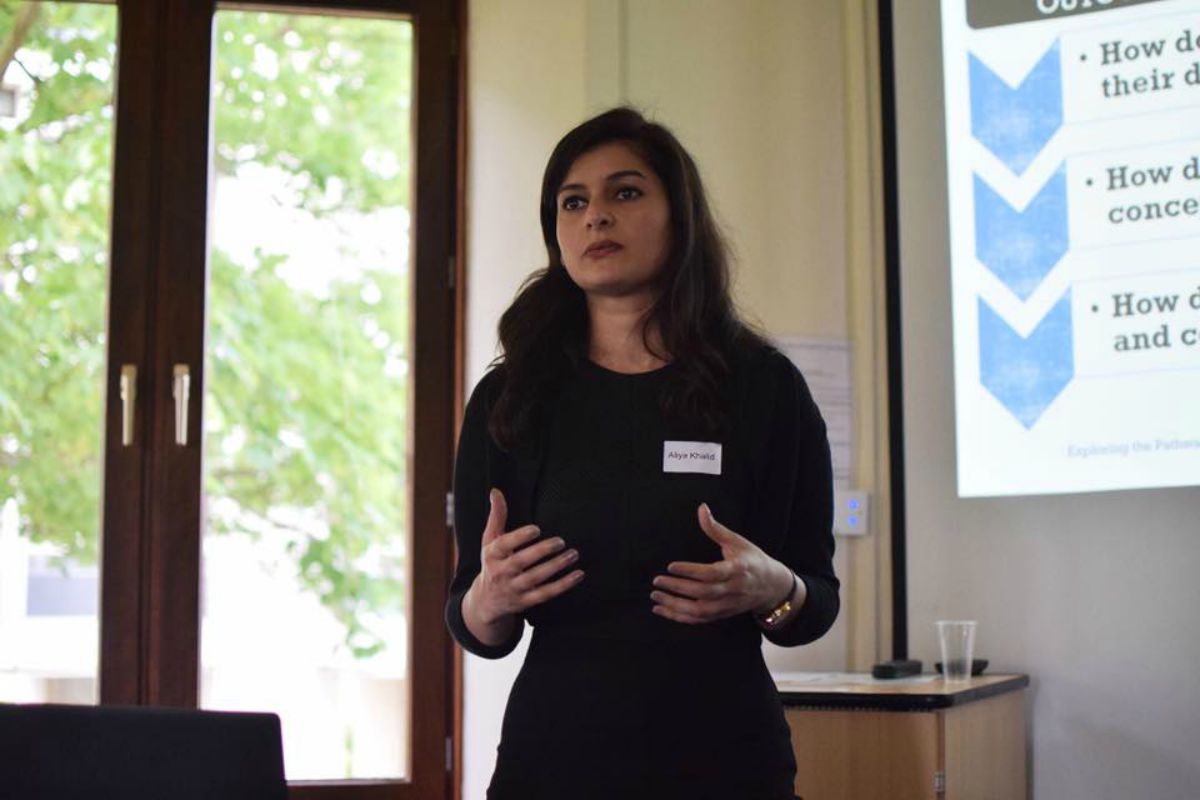
Aliya Khalid's new co-edited book foregrounds the voices of marginalised men and women and argues for the decentring of knowledge.
We cannot share a future with each other in this world of beauty and diversity unless we learn to live, respect, and give due credit to those who know their realities better.
Aliya Khalid
Gates Cambridge Scholar Aliya Khalid [2015], who did her PhD in Education and is currently based at the University of Oxford, has co-edited a book which seeks to dismantle the deficit discourses generated through research about people as agency-less and, by extension, objects of study. The Politics of Silence, Voice and the In-Between: Exploring Gender, Race and Insecurity from the Margins was published in late December and argues that, regardless of marginalisation, people create spaces of liminality where they seek control over their lives by navigating the structures that exclude them. Here she speaks about how her book came about and what it aims to achieve.
Q: What is your book about?
AK: Women’s silence, especially in contexts conventionally understood as ‘conservative,’ is often a topic of discussion for feminists and human rights advocates. While this is a worthwhile cause in matters related to international development, often the women themselves come to be seen as the objects that receive judgment about ‘why’ and “how” silence symbolises their oppression. By extension, then, ‘women’ tend to be recognised as oppressed. While, in many cases, this is true, it is also true that while living in these conditions, women continue to remain subjects capable of reflection and thought and their silence may mean many things – we need not forget that.
This book on ‘silences’ resulted from my PhD work with Pakistani mothers who engaged with their contexts in unconventional ways to enable their daughters’ education. As I learned more about the mothers I worked with in rural Pakistan I came to respect what I called their strategy of ‘silences’ – a conscious act of engaging and disengaging with life through voice, actions and aspirations (used metaphorically) to seek education for their daughters. In erasing the subjectivities of these voices, we dominate the right to produce knowledge. This book attempts to highlight the ‘knowledge of struggle’ and critiques our desire to cling to the power of knowledge production. We cannot share a future with each other in this world of beauty and diversity unless we learn to live, respect, and give due credit to those who know their realities better.
Q: Where did the idea for the book come from?
AK: The idea for the book began when I developed thinking around silence and voice as paradoxical and complex during my PhD. This later became a publication (Khalid, A. (2022). The negotiations of Pakistani mothers’ agency with structure: Towards a research practice of hearing ‘silences’ as a strategy. Gender and Education, 34(6), 659–673).
I wanted to extend this thinking to explore how we theorise the ‘in-between’ spaces of action and inaction (metaphorically, voice, and silence). My mentor in this area of work has been Professor Jane Parpart, who is one of the key thinkers in the field. Jane and I started working on the concept, and later, Jane invited our colleague Dr Georgia Holmes to join the project. The initial idea of the ‘in-between’ first came from Marianne Marchand during our panel discussion at the International Studies Association conference.
When we sent out the call, it was amazing to see the diverse perspectives on ‘agency in struggle’ that came forward. The book took on a life of its own because of the wonderful contributors and, most importantly, their deep commitment to bringing marginalised forms of struggle to the forefront. We, as editors, have been fortunate to have had the chance to work with the authors. I would never have thought that the book would bring such diverse modalities of struggle to the fore.
I want to recognise that without my colleagues (listed below) and the marginalised voices, they have brought to the fore, this project would not have been as powerful:
Dipti Tamang; Selvi Izeti; Anna-Karin Eriksson; Busra Nisa Sarac; Dafina Arifa; Debangana Chatterjee; Dixita Deka; Erin Baines; Feride Rusiti; Fred Ngokomwe; Heleen Touquet; Henri Martinen; Itziar Mujika Chao; Kalika Kastein; Ketty Anyeko; Merve Erildmen; Mimoza Salihu; Phillip Shulz; Prezarta Isma; Qendresa Prapashtica; Rose Chabot; Sebahate Paccoli Krasniqi and Tshuma Lungile Ausgustine.
Q: What do you hope for the book?
AK: I would hope that the book will initiate dialogue about the need for critical self reflection, a decentring of our own ideas of knowledge. Only after recognising that we are ignorant about many matters will we accomplish to live in harmony with the beauty and diversity of the amazing people in this world.